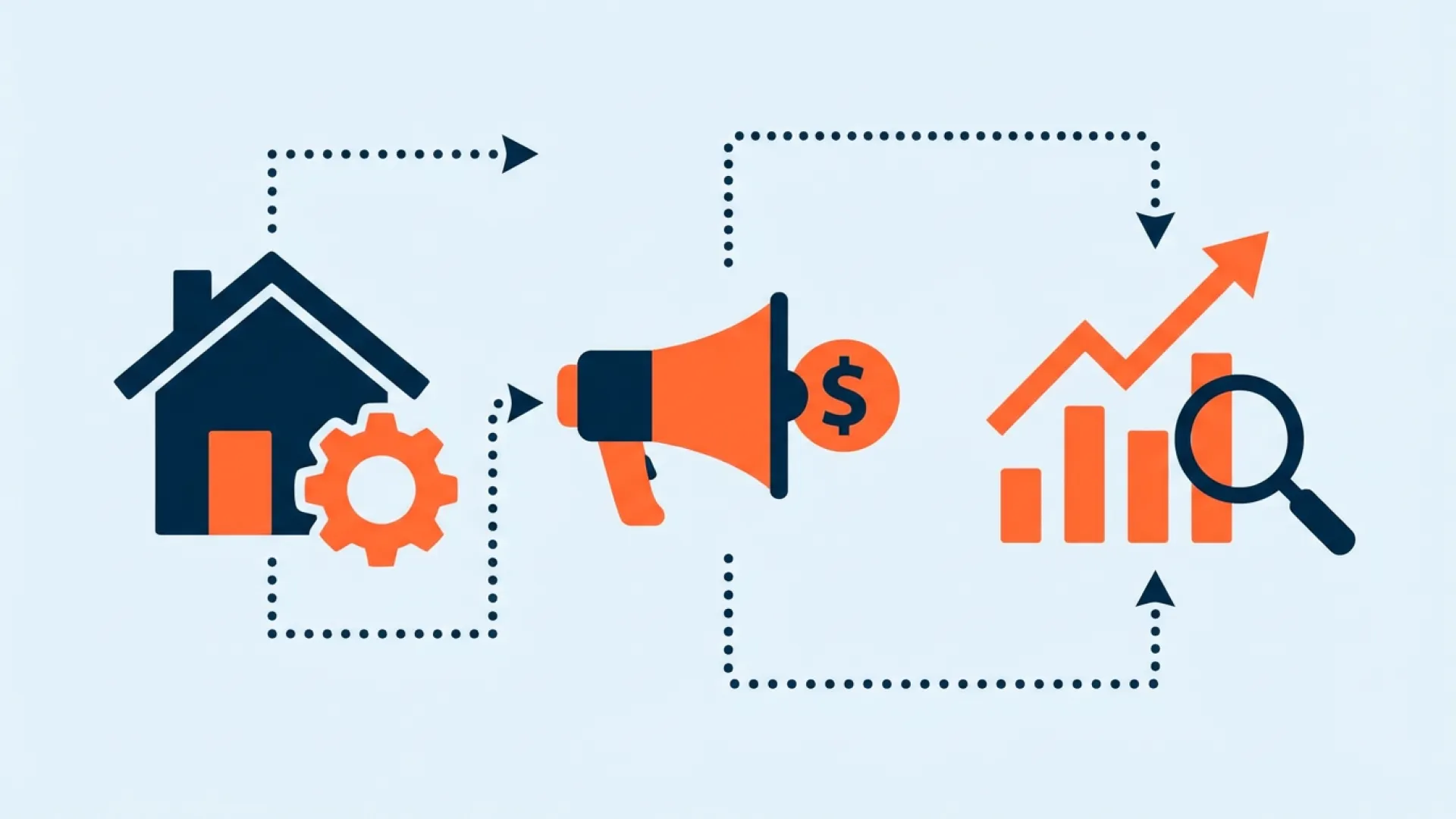
Yes, most home service companies should pay for ads—but only after their website converts and they can handle the leads. Paid advertising generates a 3:1 to 10:1 return on investment for home service businesses when managed correctly, with the average cost per lead ranging from $45 to $228 depending on your trade. The catch: running ads without the right foundation wastes money fast.
The $650-750 billion home services market is fiercely competitive. When 99% of potential customers search online for contractors, being invisible in search results means losing jobs to competitors who show up first. But "should I pay for ads?" is not a yes-or-no question—it depends on your specific situation, budget, and readiness.
Here is what the data actually says about home service advertising, when it makes sense, and when you should hold off.
Why Home Service Companies Invest in Paid Advertising
Paid advertising works differently than traditional marketing. Instead of interrupting people with billboards or mailers, PPC ads appear exactly when someone searches "emergency plumber near me" or "AC repair today." This intent-based targeting is why 40% of home services consumers who call from search make a purchase.
Immediate Visibility When Customers Need You Most
SEO takes 6-12 months to show meaningful results. Paid ads start generating leads within days.
For emergency services—burst pipes, dead HVAC systems, roof leaks—this immediacy matters critically. When someone's basement floods at 2 AM, they are not scrolling to page two of Google. They are calling whoever appears first.
The data backs this up: 78% of local mobile searches lead to a purchase within 24 hours. Paid ads ensure you are visible during that decision window.
High-Intent Customer Targeting
Unlike social media ads that interrupt people scrolling cat videos, search ads reach people actively looking for your services. Google sees nearly 180,000 monthly searches for "plumber near me" in the US alone.
You can also target by geography (only show ads in zip codes you actually serve), time (increase bids during emergency hours), device (target mobile users who are more likely to call immediately), and demographics (focus on homeowners rather than renters). This precision means your budget goes toward qualified prospects, not random impressions.
Measurable, Trackable Results
Try measuring the ROI of a truck wrap or newspaper ad. With digital advertising, you know exactly what you are getting.
PPC platforms show real-time data on how many people saw your ad (impressions), how many clicked (click-through rate), how many called or submitted forms (conversions), what you paid for each lead (cost per lead), and which keywords and ads perform best. This transparency lets you optimize continuously. Double down on what works. Cut what does not.
The Real Costs: What Home Service Ads Actually Cost
Budget conversations get vague fast. Here is what companies actually spend.
Cost Per Click by Industry
Cost per click (CPC) varies dramatically by trade and competition level. Handyman services typically see $1-$4 per click. Cleaning services run $2-$6. Plumbing and HVAC both range from $4-$15. Electrical sits around $5-$12. Roofing commands $8-$20 or more. Construction and general contracting can hit $10-$25 or higher.
Emergency keywords cost more. "Emergency plumber" commands higher CPCs than "plumbing company near me" because the searcher is more likely to book immediately.
Cost Per Lead Benchmarks
According to 2025 industry benchmarks, the average cost per lead for home services is $90.92. But this varies wildly.
The most affordable leads come from Pools and Spas at $45.15, Cleaning and Maid Services at $46.99, and Handyman at $54.05. The most expensive leads are Roofing and Gutters at $228.15, Doors and Windows at $200.34, and Construction/Contractors at $165.67.
Higher-ticket services justify higher lead costs. Paying $228 for a roofing lead that converts to a $15,000 job makes sense. Paying that for a $150 handyman job does not.
Monthly Budget Expectations
Industry guidelines suggest spending 5-12% of revenue on marketing, with a portion allocated to paid ads.
Realistic monthly ad spend ranges: new businesses testing the waters should budget $1,000-$2,500 per month. Established companies scaling can invest $2,500-$10,000 per month. Aggressive growth mode may require $10,000 or more monthly.
Starting below $1,000 per month rarely generates enough data to optimize effectively. You need sufficient clicks to identify winning keywords and ads.
The ROI Reality: Do Paid Ads Actually Work?
Spending money on ads is easy. Making money from ads requires strategy.
What Good ROI Looks Like
The standard target is 3:1 ROAS (Return on Ad Spend)—$3 in revenue for every $1 spent on ads. Top performers achieve 5:1 to 10:1 returns. The best HVAC and plumbing marketing campaigns consistently produce 500% to 1,000% ROI.
Example calculation: $3,000 monthly ad spend with $75 cost per lead generates 40 leads. At a 25% close rate, that is 10 jobs booked. With an $800 average job value, you generate $8,000 in revenue for a 2.67:1 ROAS. That might seem underwhelming, but factor in customer lifetime value. An $800 HVAC repair customer who returns for annual maintenance and eventually buys a new system could represent $5,000 or more in lifetime revenue.
Local Services Ads Performance
Google Local Services Ads (LSAs) operate differently from traditional PPC. Instead of paying per click, you pay per lead—only when someone actually contacts you through the ad.
LSA benchmarks show 20-25% conversion rates (significantly higher than traditional PPC), plus the Google Guaranteed badge builds immediate trust. The pay-per-lead model eliminates wasted clicks. For many home service businesses, LSAs provide the best starting point because risk is lower. You are not paying for tire-kickers who click but never call.
Why Some Campaigns Fail
Paid advertising is not magic. Common reasons campaigns underperform include bidding on broad keywords (targeting "plumber" instead of "emergency plumber [city]" attracts unqualified clicks from job seekers, students, and DIYers), ignoring negative keywords, sending traffic to a bad website, having no tracking in place, and impatience (campaigns need 30-60 days minimum to gather data and optimize).
Paid Ads vs. Organic Marketing: The Real Comparison
The paid vs. organic debate misses the point. They serve different purposes.
When Paid Ads Win
You need leads now. Starting a new business? Expanding to a new service area? Slow season approaching? Paid ads generate immediate visibility while SEO builds momentum.
Emergency services benefit most. When someone is searching "AC not working 110 degrees," they are not comparing blog content quality. They are calling whoever appears first. Paid ads also excel for testing new markets before committing to long-term SEO investment, and for competitive markets where organic breakthrough takes years.
When Organic Marketing Wins
Long-term cost efficiency favors organic. Organic traffic is "free" once you have built it. A blog post ranking number one for "water heater maintenance tips" generates leads for years without ongoing ad spend.
Building authority matters too. 70% of customers read reviews before hiring contractors. Educational content, strong reviews, and a robust Google Business Profile build the trust that ads cannot buy. Plus, organic efforts compound over time. Every piece of content you create, every review you earn, every backlink you build—these assets accumulate. Ad performance stays flat without increased spend.
The Best Approach: Combine Both
Relying on a single channel is risky. Algorithm changes, platform policy shifts, or increased competition can devastate your lead flow overnight.
The most resilient home service companies run paid ads for immediate, controllable lead generation; SEO for sustainable organic visibility; Google Business Profile optimization for local pack presence; review generation for social proof; and email/SMS for customer retention.
When your business shows up in paid ads, organic results, and the local map pack simultaneously, you dominate the search results page. Studies show this multi-position visibility significantly increases click-through rates.
When Home Service Companies Should NOT Pay for Ads
Here is what most advertising guides will not tell you: sometimes you should not advertise.
Your Website Is Not Ready
Running ads before fixing your website is like pouring water into a leaky bucket.
If your site loads slowly (over 3 seconds on mobile), buries your phone number, lacks trust signals (reviews, licenses, photos), has no clear call-to-action, or is not mobile-optimized, then paid traffic will bounce. You will pay for clicks that never convert. Fix your website first. Then turn on ads.
You Cannot Handle More Leads
60% of trades businesses report that labor shortages affect their ability to complete jobs on time. If you are already stretched thin, new customers wait too long and leave bad reviews, quality suffers as technicians rush between jobs, employee burnout increases turnover, and your reputation takes hits you will spend years recovering from.
Advertising more work than you can handle damages your business long-term. Scale your capacity before scaling your marketing.
Your Margins Cannot Support It
Some services have cost-per-lead that does not pencil out. Quick math: if your average job is $200, your profit margin is 30%, and your cost per lead is $150 with a 25% close rate, then your cost to acquire a customer is $600 (4 leads at $150 to get 1 customer), your profit per job is $60 ($200 times 30%), and you are losing $540 per customer.
Before advertising, know your numbers: average job value, profit margin, current close rate, and maximum acceptable cost per lead. If paid advertising does not work mathematically for your business model, focus on lower-cost channels like referrals, partnerships, and organic marketing.
You Are Not Ready to Commit
Effective PPC requires 30-60 days minimum for optimization, ongoing monitoring and adjustment, budget for at least 3-6 months of learning, and willingness to test and iterate.
Starting and stopping campaigns wastes money. Each restart begins the learning phase over. If you are not ready to commit for at least a quarter, hold off until you are.
How to Get Started the Right Way
If you have decided paid advertising makes sense for your business, here is the strategic approach.
Step 1: Fix Your Foundation First
Before spending a dollar on ads, ensure your website converts. It needs to be mobile-optimized (60% or more of searches are mobile), load under 3 seconds, have a visible and click-to-call phone number, feature clear calls-to-action ("Get Free Estimate" not "Contact Us"), display trust signals (reviews, licenses, team photos), and include service-specific landing pages.
Your tracking must work: call tracking installed with unique numbers, Google Analytics configured, conversion events defined, and CRM integration if possible. Your reviews should be solid: 4 or higher star average on Google (businesses with 4+ stars earn 32% more revenue), recent reviews within 90 days, and a response strategy for negative reviews.
Step 2: Start with Google Local Services Ads
For most home service businesses, LSAs provide the lowest-risk entry point. You pay per lead, not per click, so there is no wasted spend on non-converting traffic. The Google Guaranteed badge provides an instant trust signal. Management is simpler than traditional Google Ads. And the phone call focus is a natural fit for service businesses.
Apply for Google Guaranteed verification, set your budget, define your service areas, and you are running.
Step 3: Set Realistic Budget and Timeline
Initial budget of $1,000-$2,500 per month provides enough data to optimize without excessive risk.
Timeline expectations: weeks 1-2 involve campaign launch and initial data collection. Weeks 3-4 bring first optimizations based on early data. Month 2 reveals meaningful performance trends. Month 3 is when campaigns should be hitting their stride. Do not judge campaign success until you have 90 days of data.
Step 4: Expand Based on Results
Once LSAs perform consistently, add traditional Google Search Ads for broader keyword coverage. Test Microsoft Bing Ads (less competition, often lower CPCs). Consider Facebook and Instagram for awareness and retargeting. Implement retargeting to recapture website visitors who did not convert—retargeting ads can be 10 times more effective than standard search ads.
Reinvest profits into scaling what works. Cut what does not.
Frequently Asked Questions
-
Industry guidelines recommend 5-12% of gross revenue on total marketing, with paid advertising representing a portion of that. For a company doing $500,000 annually, that is $25,000-$60,000 in total marketing budget per year. New businesses should start with $1,000-$2,500 per month in ad spend to gather sufficient data for optimization.
-
Expect initial data within 30 days and meaningful performance trends by 60 days. Campaigns typically hit their stride around 90 days as the algorithm learns and you make data-driven optimizations. Compare this to SEO, which takes 6-12 months for significant results.
-
For most home service businesses, yes. LSAs deliver 20-25% conversion rates—significantly higher than traditional PPC—and you only pay when someone actually contacts you. The Google Guaranteed badge provides instant credibility. They are the recommended starting point for most contractors.
-
DIY is possible but requires significant time investment and willingness to learn. Mistakes are expensive when you are spending real money. Agency management fees typically run $500-$2,000 or more per month depending on ad spend and complexity. The right choice depends on whether your time is better spent running your business or managing campaigns.
-
The 2025 average is $90.92, but acceptable CPL depends entirely on your average job value and margins. A $200 CPL might be excellent for roofing ($15,000 or higher jobs) and terrible for handyman services ($200 jobs). Calculate your maximum acceptable CPL based on job value, profit margin, and close rate.
-
You can, but you will waste money. Advertising drives traffic—your website converts that traffic into leads. A slow, confusing, or untrustworthy website means you are paying for visitors who will never call. Fix your site first, then advertise.
The Bottom Line
Should your home service company pay for ads? Almost certainly yes—when the conditions are right.
Advertise when your website converts visitors to leads, you can handle increased call volume, your unit economics support customer acquisition costs, you are ready to commit for at least 90 days, and you have tracking in place to measure results.
Hold off when your website needs work, you are already at capacity, your margins cannot support lead costs, or you cannot commit time or budget consistently.
The most successful home service companies do not choose between paid and organic marketing. They build systems that leverage both—paid ads for immediate, scalable lead generation, and organic strategies for sustainable long-term growth.
Start with the foundation. Fix your website. Get your reviews up. Set up tracking. Then, when you turn on paid advertising, every dollar works as hard as possible.