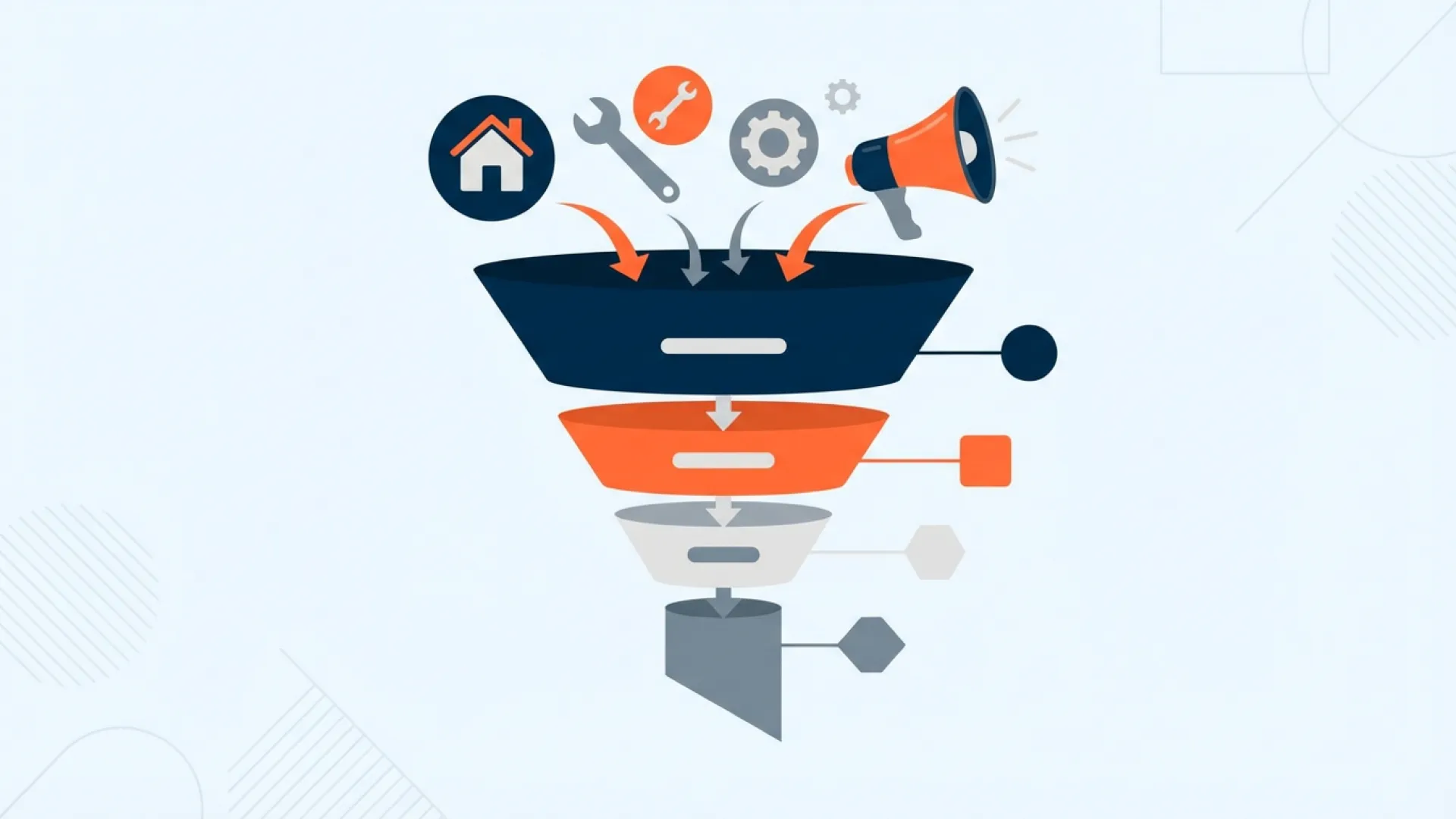
Full-funnel marketing for home service businesses means reaching customers at every stage of their journey—from the first time they see your truck in the neighborhood to the moment they call for emergency repairs. Companies that blend brand-building with targeted conversion tactics achieve 15-20% higher ROI than those focused only on lead generation, according to McKinsey research. Here's how to build a marketing system that grows your plumbing, HVAC, electrical, or roofing company predictably.
Word-of-mouth referrals and Google reviews still matter. But relying solely on them means unpredictable revenue—great one month, dry the next. The modern customer journey isn't linear. Homeowners bounce between Google searches, social media, neighborhood Facebook groups, and driving past your wrapped van before they pick up the phone. A full-funnel approach meets them at each touch point.
What Is Full-Funnel Marketing (And Why Home Services Need It)
Full-funnel marketing addresses customers at four stages: awareness (they learn you exist), consideration (they research options), conversion (they contact you), and retention (they become repeat customers and referrers). Most home service companies focus only on conversion—running Google Ads to capture people already searching for plumber near me. That works, but you're competing with every other contractor for the same small pool of ready-to-buy customers.
The Traditional Home Service Marketing Problem
Home service businesses face unique challenges. Demand is driven by urgency and seasonality. A homeowner with a burst pipe at 2 AM isn't conducting leisurely research—they call whoever comes to mind first. And during peak summer or winter, every HVAC company competes for the same desperate customers while paying premium ad rates.
One concrete company discovered the power of full-funnel thinking when they expanded beyond word-of-mouth. They started with Google Search Ads to capture immediate demand, then added Meta Ads for awareness and remarketing campaigns to stay visible. The result: more leads than they could service during peak season. The key was starting small, tracking results, and building systematically.
How Full-Funnel Differs from Lead Gen
Lead generation focuses only on bottom-funnel capture—grabbing people already searching for services. Full-funnel marketing nurtures relationships before the need arises. When a homeowner's AC fails in July, you want your company to be the first name they think of—not the third result in a frantic Google search.
| Approach | Lead Gen Only | Full-Funnel |
|---|---|---|
| Focus | Capture ready-to-buy customers | Build awareness and capture demand |
| Competition | High (everyone targets same keywords) | Lower (you create your own demand) |
| Cost Per Lead | Higher (bidding wars) | Lower over time (brand recognition) |
| Revenue Predictability | Inconsistent | More stable and scalable |
Top-of-Funnel: Building Brand Awareness
The awareness stage plants seeds. You're not asking for the sale yet—you're making sure homeowners know your company exists before they need you. This investment pays off when emergencies happen and your name comes to mind first.
Vehicle Wraps and Fleet Branding
Vehicle wraps generate 30,000-70,000 daily impressions depending on your location and driving patterns. Studies show wrapped vehicles create name recognition 15 times more effectively than other advertising types. With a 91% noticeability rate among passersby, your trucks become rolling billboards working 24/7.
Unlike recurring ad spend, vehicle wraps are a fixed investment for continuous exposure. The numbers are striking: vehicle wraps deliver 38 times more impressions per dollar than traditional advertising. Out-of-home advertising generates an average of $5.97 in product sales for every dollar spent.
Here's a tip from branding experts: feature your wrapped vehicles prominently on your website's homepage. When someone sees your truck in the neighborhood and later searches online, that visual connection builds instant trust. As branding expert Dan Antonelli notes, "When it comes time for them to make a decision about who they're choosing to do business with, your name comes top of mind."

Social Media Presence
Social media for home services isn't about going viral—it's about staying visible to your community. Post educational content like seasonal maintenance tips. Share behind-the-scenes looks at your team on job sites. Highlight community involvement and local events you sponsor.
The data supports this approach: combining out-of-home advertising with social media increases your daily reach by 212%. And 58% of consumers report going online directly after seeing an out-of-home ad—meaning your truck wrap drives traffic to your social profiles and website.
Local Sponsorships and Community Marketing
Sponsor youth sports teams, local events, and charity drives. This builds trust through community visibility and works synergistically with your vehicle branding. When parents see your logo on their kid's baseball jerseys and your truck parked in the neighborhood, the repeated exposure creates familiarity. Familiarity breeds trust. Trust converts to calls when pipes burst.
Middle-of-Funnel: Capturing Intent-Based Search
When homeowners recognize they need a service, they search. This is where you capture demand with Local SEO, Local Services Ads (LSAs), and PPC advertising. The goal: be visible when intent is highest.
Local SEO and the Map Pack
Your Google Business Profile is foundational. Optimize it with accurate service categories, service areas, business hours, and photos of completed work. Respond to every review—positive and negative—within 24 hours. Google rewards responsiveness.
Maintain consistent NAP (name, address, phone) information across all online directories. Even small inconsistencies—"Street" vs "St."—can hurt your local rankings. The map pack appears for most "near me" searches, but competition is fierce. Ranking for "HVAC near me" alone isn't enough in 2026—you need a comprehensive local presence.
Google Local Services Ads (LSAs)
LSAs appear at the very top of search results—above PPC ads, above the map pack, above organic results. They operate on a pay-per-lead model rather than pay-per-click, meaning you only pay when a potential customer actually contacts you. The average LSA cost per lead is about $60, compared to $70 for traditional search ads.
The Google Guarantee badge that accompanies LSAs tells customers that Google has vetted your business. This includes background checks on employees and verification of licensing and insurance. That badge builds instant credibility with homeowners worried about letting strangers into their homes.
LSA ranking depends on your review score, number of reviews, and responsiveness to customer inquiries. You can't simply outbid competitors to reach the top—quality and reputation matter more than budget. Google also considers geographic proximity, showing your ad to searchers closest to your service area.
PPC Advertising (Google Ads)
PPC campaigns give you more control than LSAs. You choose exact keywords, write custom ad copy, design dedicated landing pages, and set specific geographic targeting. This flexibility works well for seasonal promotions, high-margin services, or targeting customers not yet searching for local services specifically.
PPC also enables retargeting—showing ads to people who previously visited your website. This bridges the consideration and conversion stages, keeping your brand visible while homeowners compare options.
Should You Run LSAs, PPC, or Both?
Run both. Appearing in both LSA and PPC placements puts your business in front of potential customers more than once, increasing conversion likelihood. However, weight your budget toward LSAs—they capture the highest-intent local searchers at a lower cost per lead.
Start with 60-70% of your paid search budget on LSAs and 30-40% on PPC. Use PPC strategically for services LSAs don't cover well, seasonal campaigns, and retargeting. Monitor cost per lead and booking rate for each channel, then adjust allocation based on what actually drives booked jobs.
| Feature | LSA | PPC |
|---|---|---|
| SERP Position | Very top | Below LSAs |
| Pricing Model | Pay per lead | Pay per click |
| Trust Signal | Google Guarantee badge | None built-in |
| Targeting Control | Limited | Extensive |
| Retargeting | No | Yes |
Bottom-of-Funnel: Converting Leads to Customers
Driving traffic means nothing if visitors don't convert. The bottom of the funnel is where landing pages, calls-to-action, and tracking determine whether marketing spend turns into booked jobs.
Landing Page Optimization
Create dedicated landing pages for each core service rather than sending all traffic to your homepage. A homeowner searching for "emergency water heater repair" should land on a page specifically about water heater services—not a general plumbing page where they have to hunt for relevant information.
Place your value proposition above the fold. Include trust signals: licensing badges, insurance verification, review ratings, and satisfaction guarantees. Mobile optimization is critical—Ruler Analytics data shows mobile conversion rates for home services drop 40% when pages aren't optimized for single-action focus on small screens.
CTAs That Actually Convert
Use service-specific language in your calls-to-action. "Fix My AC Now" outperforms "Contact Us." "Schedule Free Estimate" beats "Learn More." Emails with a single, clear CTA see 371% more clicks than those with multiple competing options. Apply the same principle to your landing pages: one primary action per page.
Personalized CTAs perform 202% better than generic alternatives. For mobile visitors, ensure buttons meet minimum touch targets of 44-48 pixels. A/B testing CTA wording, placement, and design yields 28% higher conversion rates on average. One company changed their button from "Book a Demo" to "Talk to a Human" and saw a 110% lift in conversions.
Power words for home service CTAs: "Now," "Today," "Free," "Fast," "Emergency," "Same-Day," "Guaranteed." Match urgency level to service type—emergency services need immediate language while planned projects can focus on value.
Phone Call Tracking and Lead Attribution
Most home service leads come through phone calls, not form submissions. Without call tracking, you can't know which marketing channels drive actual booked jobs. Use unique tracking numbers for each campaign—one for LSAs, one for PPC, one for your organic listings.
Connect online leads to offline revenue by tracking the full journey: ad click to phone call to scheduled appointment to completed job. Tools like CallRail, ServiceTitan, or Housecall Pro can automate this attribution.
Post-Conversion: Retargeting and Retention
Marketing doesn't stop when the job is done. The post-conversion stage turns one-time customers into repeat clients and referral sources—the most profitable customers you can have.
Retargeting Past Website Visitors
Retargeting shows display ads to people who visited your website but didn't convert. Maybe they compared prices and got distracted. Maybe they weren't ready to commit. Retargeting keeps your brand visible during their decision-making process.
Set up dynamic retargeting ads that show the specific services visitors viewed. A homeowner who looked at your AC installation page sees ads about AC installation—not generic company ads. Target only people within your service area to avoid wasting impressions. Retargeted visitors convert at significantly higher rates than cold traffic because they already know your brand.
Email Marketing for Repeat Business
Collect email addresses during service calls and use them for ongoing relationship-building. Send maintenance reminders: "Your HVAC system was serviced 11 months ago—schedule your annual tune-up before summer." Share seasonal prep tips that position you as a helpful expert, not just a vendor.
Request reviews after completed jobs—timing matters. Send the request within 24-48 hours while the positive experience is fresh. Include a direct link to your Google Business Profile to minimize friction.
Building a Referral Engine
Create a structured referral program with clear incentives. Offer discounts on future services or gift cards for successful referrals. Make sharing easy—provide customers with a simple link or card they can hand to neighbors.
Your full-funnel digital efforts amplify word-of-mouth. When a customer refers you and their friend searches your company name, they should find a professional website, strong reviews, and consistent branding. Digital presence validates the personal recommendation.
Measuring Full-Funnel Success
Different metrics matter at each funnel stage. Tracking the right KPIs helps you understand what's working and where to invest more.
KPIs by Funnel Stage
| Funnel Stage | Key Metrics | What to Track |
|---|---|---|
| Awareness | Impressions, reach | Vehicle wrap exposure, social reach, brand search volume |
| Consideration | Traffic, engagement | Website visits, time on site, pages per session |
| Conversion | Leads, costs | Lead volume, cost per lead, booking rate |
| Retention | Lifetime value | Repeat customer rate, referral volume, customer LTV |
Attribution Across Channels
Last-click attribution—giving all credit to the final touchpoint before conversion—undervalues top-of-funnel efforts. Someone might see your truck ten times, visit your website from a social ad, then finally convert from a Google search. Last-click attribution would credit only Google, missing the awareness that made the conversion possible.
Use multi-touch attribution models when possible. At minimum, ask "How did you hear about us?" during customer intake. This simple question reveals which awareness channels are working even when digital tracking can't capture the full picture.
Getting Started: Your First 90 Days
Building a full-funnel system doesn't happen overnight. Here's a practical 90-day plan to implement this guide without overwhelming your team or budget.
Month 1: Foundation
Audit your current marketing efforts. What's working? What's not? Where are the gaps? Set up proper tracking: Google Analytics, call tracking numbers for each major channel, and a system to ask customers how they found you.
Launch or optimize your Google Business Profile—this is free and foundational. Claim your profile, add complete information, upload photos, and respond to existing reviews. Allocate a marketing budget of 5-7% of revenue to start. While referrals are "free," a dedicated budget provides stability and control over growth.
Month 2: Capture Demand
Launch Google Local Services Ads if you're eligible for your trade category. Set up basic PPC campaigns targeting your highest-intent keywords—typically "[service] + [city]" and "[service] near me" variations. Focus on services with the best margins.
Ensure your website loads fast on mobile and has clear CTAs on every page. Test your forms and phone number. A surprising number of businesses lose leads to broken contact methods.
Month 3: Build Awareness
Now that you're capturing demand, start building it. Design and install vehicle wraps on your service fleet. Create a social media content calendar with at least 2-3 posts per week. Launch retargeting campaigns for website visitors who didn't convert.
Review your first two months of data. Which channels delivered the best cost per lead? Which converted to actual booked jobs at the highest rate? Shift budget toward what's working.
Frequently Asked Questions
-
The industry benchmark is 5-7% of revenue for established businesses looking to maintain steady growth. Companies pursuing aggressive growth often invest 10-15%. Start at 5%, track your return on investment, and scale budget toward channels that deliver profitable leads. A dedicated budget provides predictability that word-of-mouth alone cannot.
-
LSAs (Local Services Ads) appear at the top of Google, charge per lead (not per click), and include a Google Guarantee trust badge. You have less control over targeting but typically pay less per actual lead. PPC (Pay-Per-Click) charges for every click regardless of conversion, but offers more control over keywords, ad copy, landing pages, and retargeting capabilities. Most home service businesses should run both.
-
Vehicle wraps build brand recognition rather than generating direct leads. Their value compounds over time—when a homeowner's pipe bursts, they remember the truck they've seen around the neighborhood. Wraps also improve digital performance: brand recognition increases click-through rates on ads. Studies show wrapped vehicles generate 30,000-70,000 impressions daily and are 15x more effective at name recognition than other advertising.
-
\"Bottom-funnel tactics (LSAs, PPC) can generate leads within days to weeks of launching. Top-funnel awareness efforts (vehicle wraps, social media, community marketing) typically take 3-6 months to show measurable impact on lead volume and conversion rates. Full system optimization—where all stages work together efficiently—generally takes 6-12 months to mature."
Build Your Marketing System
Full-funnel marketing transforms home service businesses from reactive to proactive. Instead of waiting for referrals or competing in bidding wars for ready-to-buy customers, you build a system that creates demand and captures it efficiently.
Each stage supports the others. Vehicle wraps make your PPC ads more recognizable. LSAs capture the demand your awareness efforts create. Retargeting converts the visitors your SEO attracts. Email marketing turns customers into referral sources who feed the top of your funnel.
Start where you are. You don't need to implement everything at once. Audit your current gaps, prioritize one improvement per funnel stage, and build systematically. The companies that win in home services aren't necessarily the biggest—they're the ones that show up consistently at every stage of the customer journey.